(This was a post on my blog from a few months ago that I took down. The numbers in this post were arrived at during the course of one train ride from New Jersey to NYC, and in no way are derived from any real consulting firm. These are numbers that should be considered if you are going to start your own IT consulting firm. I also included some of the comments that the original post garnered.)
Consulting Firms - What Should We Charge?
On another blog, a person who is in charge of some consulting dollars (or pounds) at his company questioned why they should pay $X to one consulting company when some temp contractors could do it for $0.5X.
That got me thinking (yet again) about how much high-end consultancies should charge a client per hour or per professional day. I came up with some numbers that I would like to share.
Before I start, some things I want to mention:1) Please feel free to comment in case my numbers are way off base.2) The numbers have no connection whatsoever with Finetix, my former employer. These numbers were arrived at by opening up a random number of fortune cookies and summing up the lottery numbers. 3) These figures are for the US marketplace. I have no idea what the British equivalents to Social Security Tax and 401K plans are.
Fixed Costs Per Employee
------------------------
1) Salary
We want to have a consultancy that has top technical people who have some amount of financial background. We are looking for .NET and Java experts who have done some work on Wall Street in the past, and who can at least tell me what a bond is. In a previous blog posting, I mentioned that the current base salary on Wall Street for this level is about $150,000.
2) 401K/retirement Plan
Let's say that you have a 3% 401K. That adds another $5000.
3) Bonus
Always a tricky thing. Let's take $10,000 for a job well done.
4) Insurance
We pay 2/3 of an employees medical and dental insurance. This amount to about $7000 per year. We also have to pay some other taxes, such an unemployment insurance, etc.
5) Social Security tax
We pay about 7.15 of the person's first $90,000 in income. This is about $6000.
Subtotal - We are paying about $178,000 in salary and benefits per employee.
Costs of Running the Business
-----------------------------
1) Back office staff to support 40 delivery people. We need about 10 people. There are 3 partners, director of Human Resources, director of Benefits, director of Recruiting, two salespeople, director of marketing, plus administrative assistant. If we wanted to chop some dollars, we could probably combine the HR and Benefits. Some of the people are paid totally on commission, some partly, and some are strictly salaried. The partners pay themselves a fixed base salary. So, I am going to put this roughly at $1M.
2) Rent
Nice offices in New York, satellite offices in various locations. Also, cost of utilities, cleaning services, a nice tip for the elevator operators and cleaning people, etc. Let's estimate $400,000.
3) Office Supplies, Furniture, Postage, ISP, etc.
Let's say $100,000.
4) Other items:
- Interest on the Float. The "float' is the number of days between the time you pay your employees and the time you finally collect money from the client.
- Client "incentives" - that nasty, unspoken cost of doing business.
- Marketing Budget
- Conferences and professional organizations
5) Corporate Taxes!!!!
Subtotal - Let's guess about $2M. If we have 40 consultants generating revenue, this is about $50,000 per consultant.
So, now we have the cost per consultant at around $230,000 per year. There are about 230 possible consulting days per year (365 days - 104 weekends - 15 vacation - 10 holidays plus some sick days). This means, if the consultant was billing for all 230 days, we would have to charge the client $1000 per day just to break even. Now, let's say that each consultant is allowed about 10 days of bench time per year. This brings our daily rate up to about $1100.How much profit margin should the partners have? From dealing with various headhunters, I would assume a good profit margin to be about 25-30%. This means that we should be charging a client about $1400 for a consultant.
Our consulting company has a mixture of various skill levels. Some people are more junior than others. So, we create a rate card that goes from $1200 per day for a junior person, to $1600 per day for a senior person. This comes out to $150 to $200 per hour.
Now, at that rate, we are relatively cheap compared to other consulting companies. Microsoft Consulting charges at least $2000 per day. IBM and BearingPoint charge at least $250 per hour for a junior consultant, up to about $450 an hour for a director.
Who are our customers? Certainly, the tier 1 and tier 2 financial institutions. Pharma companies are not going to pay these rates. We are looking to deal with clients who can appreciate our talent pool and who can afford to pay.
Wanna start your own consultancy? These are the numbers that you will have to deal with.
8 Comments:
· I think you're a little on the low side. My former employer charged $250 to $320 per hour, and we had pharmas and other corporates in our clientelle.In yours costs, perhaps factor in some free consulting time to fix screw-ups, late deliveries, etc.What about training? If you want to justify your rate you need highly trained, up to date employees. This is why I left, my employer made no investment in me. I had to train myself on my time, which left me often working around the clock.10 days on the bench per year! Man, I do NOT miss consulting!
By Burnt Out, at 5:38 PM
· Wouldn't the partners take a % of the profits rather than a salary?What about training, free days to clients, sick days?Why isn't the employees bonus based on a % of the profits the company makes?Based on your calculations the is a backoffice person for every 4 consultants? I hate to see the size of the backoffice for 1000 consultantsWhy don't I offshore some of my the work?Can't your consultancy do fixed price?
By Anonymous, at 6:30 PM
· Wouldn't the partners take a % of the profits rather than a salary?Possibly. Depends on how risk-averse the partners were. If I was a partner, I would pay myself a low salary ($100K) and then at the end of the year, divvy up the profits.What about training, free days to clients, sick days?I mentioned 5 sick days in my original post. Training is nice, and I would like to give at least a week of training, so that can be done during the 10 days of bench time. OK, let's add in about $100K for training. Free days to clients? Never heard of this!Why isn't the employees bonus based on a % of the profits the company makes?Because many smart people will negotiate a guaranteed fixed bonus when they join, especially since the debacles of 2002 and 2003. But I might give an added "incentive" bonus to some of my best performers at the end of the year. OK, let's add another 100K.Based on your calculations the is a backoffice person for every 4 consultants? I hate to see the size of the backoffice for 1000 consultants10 people should be a constant. Even when your company grows to 100 people. In fact, at the start, I might consider consolidating the benefits and HR functions, and make the partners do more marketing. So, we can cut our staff back to 8.Why don't I offshore some of my the work?Never, never! This is what distinguishes my shop from other larger ones. Strictly all client-facing work.Can't your consultancy do fixed price?I abhor fixed-price contracts. We could do it, but perhaps under duress!One thing that I forgot to mention was finder’s fees. If I hire a person through an employment agency, then I have to pay then 15-30% of the employee's first year salary. That's a significant chunk. Let's assume $30,000 for 10 people, and that's another $300,000.So, we have added another $500,000 in costs to our model. That's about $10K per employee. Gotta bump up the rate card by $50 per day. So, our rate card is now $1250 through $1650. And, coincidentally, $1650 per day is what a lot of the top-tier banks pay for senior technical people.
©2006 Marc Adler - All Rights Reserved
Monday, July 31, 2006


Wednesday, July 26, 2006
The Start of a New Adventure
On the eve of starting a great, new, exciting position, I would like to recap my experiences over the past 4 weeks in searching for a new job. One of the motivating factors in looking for a new job was that I wanted to have an important role in shaping the development and architecture of a major financial system, and do so at a senior level. Being a hands-on coder was OK for me on a part-time basis, but I wanted to manage and mentor developers who would be doing most of the coding while devoting more of my time to learning about new technologies in the financial arena, meeting with vendors, sitting on enterprise architecture committees, etc.
It’s always good to have some throwaway interviews, especially if you have not interviewed in quite a while. As soon as I announced my intentions of moving on to something different, I received a number of calls for interviews. I knew that some of the positions were not right for me, but I needed to get some spit and polish on my interviewing style before going out to the big boys.
The first interview was for a consulting company that claimed to do some financial work, but whose main focus was content management. Nevertheless, I needed to meet with people, so I went down for the interviews. The company had a “boiler room” full of cold-callers, something that makes my blood curdle. I met with the “HR lady” and then (believe it or not), the Head of Business Development. What kind of company would have you meet with their head salesperson? After my ideas about how a consulting company should be run went right over the salesguy’s head, I met with one of the partners. He was more perceptive, in that when I told him that I did not want to work for a consulting company that had the singleton, bodyshopping model, I could detect the dark cloud passing over his face and his immediate desire to end the interview as soon as possible.
The next day was another throwaway. A hedge fund had been after me for a few months. The headhunter told me that, as part of the job spec, the hedge fund requested that candidates live in New York City so that they could be on constant call. 14 hour days were the minimum. Joking with the headhunter, I told him that if I were to work 14 hour days, that I would want my current salary * 1.75 as a base. He called me back a week later and said that the hedge fund still wanted to talk to me. After an initial phone interview, I went down to see the people from the hedge fund. The fund is technically astute; they were developing totally in .NET 2.0, although they were doing all ASP.NET apps. The only thing that the first two interviewers, both developers, did was to repeatedly thumb through my resume, and exclaim that I had done a lot of stuff. Finally, I interviewed with the CTO. We talked about a lot of conceptual things, and he asked me one SQL question, which I got about half right. (I happen to have a mental block when it comes to writing SQL during an interview – give me SQL Query Analyzer, and I can work up the answer in 5 minutes). When the CTO asked me about my compensation requirements, I told him that I thought that the recruiter communicated that to him already. The recruiter never did, and when I mentioned the figure to him, he rolled onto the floor laughing. We ended the interview about 8PM, and he told me that his day was just beginning.
Two interviews without a good tech question.
The next interview was with another, very small hedge fund. The CTO was a really nice guy, except that I wanted his job! The pay was terrible. About 60% of my current base, although a 30-40% bonus was typical. To his credit, the CTO knew that he could not support my compensation level, and we both knew that it would have been a mismatch if I had joined.
Still no tech questions.
Later that day, I went down for a face-to-face with a very small company that specialized in financial tools. I had actually spoken briefly to this company a few months ago, but they really wanted a GUI developer who specialized in C++. Seeking a good throwaway interview with some good, hard tech questions, I contacted this company again to see if the position was open. It was! I had an initial one-hour phone conversation with their senior developer, and then was invited down to their offices for a second round. The questions I was asked included:
- Design the architecture and the API for a logging mechanism
- Implement a breadth-first and depth-first search for a tree.
- Design a hash table.
- Implement a workflow manager.
When the CEO of the company walked in to interview me, I almost fainted. The CEO looked like he was 12 years old. (He is actually a MIT grad.) I felt like I was interviewing my son. OK, I think that we both realized at that point that there was a slight cultural difference!
A phone interview with one of the big IBs followed. The job spec was for a C# developer for an Order Management System, but the recruiter kept insisting that it was a Managing Director’s position. I told the recruiter specifically that I did not want an Associate Director or Director position at this company, but she kept changing her story with regards to the title. The phone interview was a non-event. No tech questions; just a manager going over my past projects and asking me where I wanted to be five years from now. A very, very dry interview.
Then came two wonderful interviews with two different groups at an IB, one for consulting and one for full-time. I got offers from both these interviews. More on this later. I was asked to design a crossing engine. I was asked about the .NET garbage collector. I was asked to draw an architecture for a trading system. I was asked about bottlenecks in the system.
I got verbal offers from both of these groups the next day.
I knew that I was going to take one of these two positions, but I went on two other interviews as backups. One was with a big ad agency who needed rearchitecture of some big websites. Nice company located in the hinterlands of New Jersey, and they came through with a very nice consulting offer at a pretty good rate. It would have been a good change of pace, and I would have taken it if the other offers did not come through. Another interview was a phone talk with the head dev and the manager of a group at another IB. Their systems were in a mess, and they needed rearchitecture and new development on their big Private Banking systems. Not really a position that I wanted. Both of these interviews contained no tech questions.
One other background conversation was with a small company that specialized in software and consulting services for hedge funds. Really nice guys, and would have been great if I had wanted to bill by the hour and customize software for individual funds, but they were looking at me to take over the CTO role. Unfortunately, they did not have a sufficient revenue stream to support non-client-billable activities, and sadly, it would have been more of singleton consulting.
In the course of interviewing, I met some very good recruiters who I will be sure to use in my new position when I need staff. I also met some very, very bad recruiters who a) did not communicate salary requirements to their clients, b) did not give me feedback, c) lied about the titles of the positions. Among the goodies I met were Matt of SH and Drew of CMA. Cheers guys!
I was disappointed in the level of tech questions that I received, and was surprised that most of the interviewers would just spend time gawking at my resume. They were actually embarrassed to ask me the generic tech questions (ie: what is a virtual function, what is a delegate, etc). However, the design-a-system questions were good, and I have to remember to use some of them, especially the one about designing a workflow engine.
My new position is a senior-level position at one of the IBs. I will be in charge of architecting some new trading systems and rearchitecting some older ones. I will have a small staff of good people. My manager is a very dynamic personality, and I am hoping that we can move this organization forward in terms of trading technology. I will be involved in new technologies (to me, at least), and will be investigating low-latency market data distribution, algorithmic trading, universal GUIs (my Wall Street Stack), and more.
©2006 Marc Adler - All Rights Reserved
It’s always good to have some throwaway interviews, especially if you have not interviewed in quite a while. As soon as I announced my intentions of moving on to something different, I received a number of calls for interviews. I knew that some of the positions were not right for me, but I needed to get some spit and polish on my interviewing style before going out to the big boys.
The first interview was for a consulting company that claimed to do some financial work, but whose main focus was content management. Nevertheless, I needed to meet with people, so I went down for the interviews. The company had a “boiler room” full of cold-callers, something that makes my blood curdle. I met with the “HR lady” and then (believe it or not), the Head of Business Development. What kind of company would have you meet with their head salesperson? After my ideas about how a consulting company should be run went right over the salesguy’s head, I met with one of the partners. He was more perceptive, in that when I told him that I did not want to work for a consulting company that had the singleton, bodyshopping model, I could detect the dark cloud passing over his face and his immediate desire to end the interview as soon as possible.
The next day was another throwaway. A hedge fund had been after me for a few months. The headhunter told me that, as part of the job spec, the hedge fund requested that candidates live in New York City so that they could be on constant call. 14 hour days were the minimum. Joking with the headhunter, I told him that if I were to work 14 hour days, that I would want my current salary * 1.75 as a base. He called me back a week later and said that the hedge fund still wanted to talk to me. After an initial phone interview, I went down to see the people from the hedge fund. The fund is technically astute; they were developing totally in .NET 2.0, although they were doing all ASP.NET apps. The only thing that the first two interviewers, both developers, did was to repeatedly thumb through my resume, and exclaim that I had done a lot of stuff. Finally, I interviewed with the CTO. We talked about a lot of conceptual things, and he asked me one SQL question, which I got about half right. (I happen to have a mental block when it comes to writing SQL during an interview – give me SQL Query Analyzer, and I can work up the answer in 5 minutes). When the CTO asked me about my compensation requirements, I told him that I thought that the recruiter communicated that to him already. The recruiter never did, and when I mentioned the figure to him, he rolled onto the floor laughing. We ended the interview about 8PM, and he told me that his day was just beginning.
Two interviews without a good tech question.
The next interview was with another, very small hedge fund. The CTO was a really nice guy, except that I wanted his job! The pay was terrible. About 60% of my current base, although a 30-40% bonus was typical. To his credit, the CTO knew that he could not support my compensation level, and we both knew that it would have been a mismatch if I had joined.
Still no tech questions.
Later that day, I went down for a face-to-face with a very small company that specialized in financial tools. I had actually spoken briefly to this company a few months ago, but they really wanted a GUI developer who specialized in C++. Seeking a good throwaway interview with some good, hard tech questions, I contacted this company again to see if the position was open. It was! I had an initial one-hour phone conversation with their senior developer, and then was invited down to their offices for a second round. The questions I was asked included:
- Design the architecture and the API for a logging mechanism
- Implement a breadth-first and depth-first search for a tree.
- Design a hash table.
- Implement a workflow manager.
When the CEO of the company walked in to interview me, I almost fainted. The CEO looked like he was 12 years old. (He is actually a MIT grad.) I felt like I was interviewing my son. OK, I think that we both realized at that point that there was a slight cultural difference!
A phone interview with one of the big IBs followed. The job spec was for a C# developer for an Order Management System, but the recruiter kept insisting that it was a Managing Director’s position. I told the recruiter specifically that I did not want an Associate Director or Director position at this company, but she kept changing her story with regards to the title. The phone interview was a non-event. No tech questions; just a manager going over my past projects and asking me where I wanted to be five years from now. A very, very dry interview.
Then came two wonderful interviews with two different groups at an IB, one for consulting and one for full-time. I got offers from both these interviews. More on this later. I was asked to design a crossing engine. I was asked about the .NET garbage collector. I was asked to draw an architecture for a trading system. I was asked about bottlenecks in the system.
I got verbal offers from both of these groups the next day.
I knew that I was going to take one of these two positions, but I went on two other interviews as backups. One was with a big ad agency who needed rearchitecture of some big websites. Nice company located in the hinterlands of New Jersey, and they came through with a very nice consulting offer at a pretty good rate. It would have been a good change of pace, and I would have taken it if the other offers did not come through. Another interview was a phone talk with the head dev and the manager of a group at another IB. Their systems were in a mess, and they needed rearchitecture and new development on their big Private Banking systems. Not really a position that I wanted. Both of these interviews contained no tech questions.
One other background conversation was with a small company that specialized in software and consulting services for hedge funds. Really nice guys, and would have been great if I had wanted to bill by the hour and customize software for individual funds, but they were looking at me to take over the CTO role. Unfortunately, they did not have a sufficient revenue stream to support non-client-billable activities, and sadly, it would have been more of singleton consulting.
In the course of interviewing, I met some very good recruiters who I will be sure to use in my new position when I need staff. I also met some very, very bad recruiters who a) did not communicate salary requirements to their clients, b) did not give me feedback, c) lied about the titles of the positions. Among the goodies I met were Matt of SH and Drew of CMA. Cheers guys!
I was disappointed in the level of tech questions that I received, and was surprised that most of the interviewers would just spend time gawking at my resume. They were actually embarrassed to ask me the generic tech questions (ie: what is a virtual function, what is a delegate, etc). However, the design-a-system questions were good, and I have to remember to use some of them, especially the one about designing a workflow engine.
My new position is a senior-level position at one of the IBs. I will be in charge of architecting some new trading systems and rearchitecting some older ones. I will have a small staff of good people. My manager is a very dynamic personality, and I am hoping that we can move this organization forward in terms of trading technology. I will be involved in new technologies (to me, at least), and will be investigating low-latency market data distribution, algorithmic trading, universal GUIs (my Wall Street Stack), and more.
©2006 Marc Adler - All Rights Reserved
Tuesday, July 25, 2006
Testing, Testing
Anyone out there still?
Important announcement coming soon....
©2006 Marc Adler - All Rights Reserved
Important announcement coming soon....
©2006 Marc Adler - All Rights Reserved
Monday, June 26, 2006
Next Move
I am in the market for new opportunities. My interests are hedge funds, trading technology, .NET.
If you have something interesting going on, please email me at magmasystems@yahoo.com
I am going to take a few weeks off, investigate technologies that I have been too busy to investigate, and watch the rest of the World Cup.
©2006 Marc Adler - All Rights Reserved
If you have something interesting going on, please email me at magmasystems@yahoo.com
I am going to take a few weeks off, investigate technologies that I have been too busy to investigate, and watch the rest of the World Cup.
©2006 Marc Adler - All Rights Reserved
Sunday, June 25, 2006
Things to Learn
Going through some of the reading from SIA. Tons and tons of stuff out there. On my "to-learn" list are:
MDDL - market data definition language, yet another XML-based way of transmitting financial info
Gigaspaces - grid-based infrastructure
Vhayu - real-time and historical data storage with real-time calculations and event broadcasting
Wombat - another high-speed market data and messaging platform
©2006 Marc Adler - All Rights Reserved
MDDL - market data definition language, yet another XML-based way of transmitting financial info
Gigaspaces - grid-based infrastructure
Vhayu - real-time and historical data storage with real-time calculations and event broadcasting
Wombat - another high-speed market data and messaging platform
©2006 Marc Adler - All Rights Reserved
Another Interesting Job Posting
http://newyork.craigslist.org/mnh/sof/173118487.html
They are located on the 4th floor of a building on Franklin Street, which is in the area of New York City called TriBeCa. In the old days, Franklin Street had many spacious lofts ... which got me thinking back to the days where a lot of young software companies worked out of lofts or apartments. In fact, in 1986, I worked for a young startup called Multex. There were 3 or 4 of us sitting in an apartment on West 53rd Street, coding apps for Goldman Sachs. Multex went on to expand, go public, and get bought out by Reuters.
Former Multex employee Brett Schlussman left just after me, and formed NetLogic with another former Multex guy (Michael St. Hippolyte) and a developer from Bankers Trust. They worked out of Brett's apartment in the 20's, taking Brett's Windows-based 3270 emulator that he developed for First Boston and selling it to Eicon.
We have interviewed a number of ex-Multex employees recently at Finetix. These were people who joined Multex after the Reuters merger. They had no idea that they were being interviewed by Multex employee number 5.
©2006 Marc Adler - All Rights Reserved
They are located on the 4th floor of a building on Franklin Street, which is in the area of New York City called TriBeCa. In the old days, Franklin Street had many spacious lofts ... which got me thinking back to the days where a lot of young software companies worked out of lofts or apartments. In fact, in 1986, I worked for a young startup called Multex. There were 3 or 4 of us sitting in an apartment on West 53rd Street, coding apps for Goldman Sachs. Multex went on to expand, go public, and get bought out by Reuters.
Former Multex employee Brett Schlussman left just after me, and formed NetLogic with another former Multex guy (Michael St. Hippolyte) and a developer from Bankers Trust. They worked out of Brett's apartment in the 20's, taking Brett's Windows-based 3270 emulator that he developed for First Boston and selling it to Eicon.
We have interviewed a number of ex-Multex employees recently at Finetix. These were people who joined Multex after the Reuters merger. They had no idea that they were being interviewed by Multex employee number 5.
©2006 Marc Adler - All Rights Reserved
Wednesday, June 21, 2006
SIA Technology Show 2006
I stopped by the Securities Industry Association show at lunchtime today. Walked around the exhibit hall and saw 1000 different instances of "the Wall Street Stack". Ow .... my head hurt from thinking about how many times the same stack has been rewritten in different ways for the sole purpose of displaying real-time charts and blotters. If you were a financial software company, how much would you pay for a completely operational version of The Stack?
Picked up a least 50 magazines, newsletters, and newspapers on trading technologies (hardly anyone was giving out T-Shirts this year -- I am a real T-Shirt collector). Waters Magazine still seems to be the best one out there for hard-core Wall Street developers.
There was a nice article on pages 21 and 22 of the Summer 2006 issue of Windows in Financial Services on a framework that I helped architect at Wachovia last year. The framework is what they now call OneSource. Several apps in Wachovia are based on OneSource, and I am happy to report that the ClientNet application that I worked on last year is being rolled out worldwide at Wachovia. One of the mags had a nice bit on the adoption of grid technololgies within Wachovia --- my man R.O. rolled that stuff out.
Larry from Finetix gave a nice talk on Quality Assurance in Capital Markets. Hopefully, some past and current clients attended that one! Larry is one of the best in the business.
Fourth of July coming up .... we have to get ourselves out to Block Island

©2006 Marc Adler - All Rights Reserved
Picked up a least 50 magazines, newsletters, and newspapers on trading technologies (hardly anyone was giving out T-Shirts this year -- I am a real T-Shirt collector). Waters Magazine still seems to be the best one out there for hard-core Wall Street developers.
There was a nice article on pages 21 and 22 of the Summer 2006 issue of Windows in Financial Services on a framework that I helped architect at Wachovia last year. The framework is what they now call OneSource. Several apps in Wachovia are based on OneSource, and I am happy to report that the ClientNet application that I worked on last year is being rolled out worldwide at Wachovia. One of the mags had a nice bit on the adoption of grid technololgies within Wachovia --- my man R.O. rolled that stuff out.
Larry from Finetix gave a nice talk on Quality Assurance in Capital Markets. Hopefully, some past and current clients attended that one! Larry is one of the best in the business.
Fourth of July coming up .... we have to get ourselves out to Block Island

©2006 Marc Adler - All Rights Reserved
Tuesday, June 20, 2006
Derman is in the House
Famed quant Emanuel Derman is blogging.
http://www.wilmott.com/blogs/eman/index.cfm
I just started reading his book My Life as a Quant. Interesting to read his experiences at Bell Labs at the start of the whole Unix/C movement in the late 1970's.
I will definitely have some more comments as I read through the book.
©2006 Marc Adler - All Rights Reserved
http://www.wilmott.com/blogs/eman/index.cfm
I just started reading his book My Life as a Quant. Interesting to read his experiences at Bell Labs at the start of the whole Unix/C movement in the late 1970's.
I will definitely have some more comments as I read through the book.
©2006 Marc Adler - All Rights Reserved
Sunday, June 18, 2006
Friday, June 16, 2006
YABGT (Yet Another Bill Gates Tribute)
I will join all of the other bloggers out there and put in my two cents about Bill Gates.
I had my first and only brush with Gates back in 1991 or 1992. I was a contributing editor for Microsoft Systems Journal back in the old days. One day, I get a call from my editor. He tells me that Bill Gates is stopping in New York for a night, on his way back to Seattle from a European trip. He wanted to have dinner with the MSJ contributing editors to tell them about some exciting stuff in the industry. Would I be interested?
We all met at a Japanese hotel on Park Ave at 32nd St. This hotel had a beautiful restaurant, and Gates, being a sushi fanatic, reserved a tatani room for us.
We all get there at 8PM, and then in walks Gates, followed by his flack, Jon Lazarus (who used to be the publisher of MSJ). In attendance was myself, Ross Greenburg (author of RamNet, and later, some virus-checking program), Greg Comeau (author of Comeau C++), Charles Petzold (author of a book), and Tony Rizzo (my editor).
Gates turned out to be a great guy, despite the constant leg movements under the table. Very personable. He spent most of the night talking about getting Dave Cutler from DEC, and the new operating system he was working on (Windows NT). Every word was preceeded by a stern warning from Lazarus never to repeat what was said.
Of course, the very next week, PC Week featured a big story on Cutler and NT!!!
©2006 Marc Adler - All Rights Reserved
I had my first and only brush with Gates back in 1991 or 1992. I was a contributing editor for Microsoft Systems Journal back in the old days. One day, I get a call from my editor. He tells me that Bill Gates is stopping in New York for a night, on his way back to Seattle from a European trip. He wanted to have dinner with the MSJ contributing editors to tell them about some exciting stuff in the industry. Would I be interested?
We all met at a Japanese hotel on Park Ave at 32nd St. This hotel had a beautiful restaurant, and Gates, being a sushi fanatic, reserved a tatani room for us.
We all get there at 8PM, and then in walks Gates, followed by his flack, Jon Lazarus (who used to be the publisher of MSJ). In attendance was myself, Ross Greenburg (author of RamNet, and later, some virus-checking program), Greg Comeau (author of Comeau C++), Charles Petzold (author of a book), and Tony Rizzo (my editor).
Gates turned out to be a great guy, despite the constant leg movements under the table. Very personable. He spent most of the night talking about getting Dave Cutler from DEC, and the new operating system he was working on (Windows NT). Every word was preceeded by a stern warning from Lazarus never to repeat what was said.
Of course, the very next week, PC Week featured a big story on Cutler and NT!!!
©2006 Marc Adler - All Rights Reserved
Sunday, June 11, 2006
Thursday, June 01, 2006
Housing Price Futures
I heard about this on NPR radio the other day ... A great way of hedging a housing market. If you are buying now, and are afraid that the housing market might fall through the floor in your town, then you can short the housing future. If you think that your area might see an uptick in housing, then long the future.
(from a CBS Marketwatch article)
The Chicago Merc introduced cash-settled futures and options based on housing markets in Boston, Chicago, Denver, Las Vegas, Los Angeles, Miami, New York, San Diego, San Francisco and Washington, as well as a weighted composite index.
The contracts are priced by multiplying the index value by $250; the average contract size for the various cities is roughly $55,000, although they vary by region, according to Sayee Srinivasan, associate director of research and product development at the CME. He said the exchange is considering adding contracts for other booming real-estate markets such as Phoenix and Orlando.
"The futures markets like volatility, so the contracts based on the most volatile housing markets might see the most volume," Srinivasan said.
For each region, there are four contracts, which expire on a quarterly basis, so there are currently contracts for August 2006, November 2006, February 2007 and May 2007.
Although the contracts have only been trading for a very short period, most of the interest is looking further out on the curve with the May 2007 contracts getting the most action initially, said Fritz Siebel, senior broker at Traditional Financial Services Inc.
There could be demand for longer-dated contracts, something the CME is considering if the existing contracts prove popular enough.
Siebel noted the early interest has been in derivatives based on hot West Coast markets in San Diego, Los Angeles and Las Vegas, and also Miami on the East Coast.
©2006 Marc Adler - All Rights Reserved
(from a CBS Marketwatch article)
The Chicago Merc introduced cash-settled futures and options based on housing markets in Boston, Chicago, Denver, Las Vegas, Los Angeles, Miami, New York, San Diego, San Francisco and Washington, as well as a weighted composite index.
The contracts are priced by multiplying the index value by $250; the average contract size for the various cities is roughly $55,000, although they vary by region, according to Sayee Srinivasan, associate director of research and product development at the CME. He said the exchange is considering adding contracts for other booming real-estate markets such as Phoenix and Orlando.
"The futures markets like volatility, so the contracts based on the most volatile housing markets might see the most volume," Srinivasan said.
For each region, there are four contracts, which expire on a quarterly basis, so there are currently contracts for August 2006, November 2006, February 2007 and May 2007.
Although the contracts have only been trading for a very short period, most of the interest is looking further out on the curve with the May 2007 contracts getting the most action initially, said Fritz Siebel, senior broker at Traditional Financial Services Inc.
There could be demand for longer-dated contracts, something the CME is considering if the existing contracts prove popular enough.
Siebel noted the early interest has been in derivatives based on hot West Coast markets in San Diego, Los Angeles and Las Vegas, and also Miami on the East Coast.
©2006 Marc Adler - All Rights Reserved
Wednesday, May 24, 2006
FX Settlements
The CLS website has a great picture on how settlements work for FX trades. Here it is:
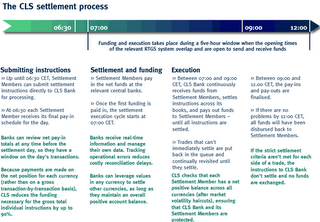
CLS is a bank set up by a consortium of different financial firms. It what my client uses for settling their FX trades.
©2006 Marc Adler - All Rights Reserved

CLS is a bank set up by a consortium of different financial firms. It what my client uses for settling their FX trades.
©2006 Marc Adler - All Rights Reserved
Services for the Wall Street Stack
I have blogged before about the need for a standardized Wall Street Stack. At my current client, there are several different frameworks that have been built over the years, but no framework has gained enterprise-wide acceptance.
These are the services that are generally needed for a complete application framework. If you can think of any other, let me know.
Authentication - logging in to various databases, web servers, internal systems, etc. Best implemented through an enterprise-wide authentication service (using the user's Kerberos token, etc)
Authorization (Entitlements) - what actions can a user perform within an application and what data is a user entitled to see. Best accomplished through an enterprise-wide system.
Logging - log interesting things that happen in an application. Log4Net is a good framework.
User Preferences - load and save the state of the UI
User Data - each application may want to persist the last state of the application when the user logged off
Configuration - Each application should be configurable through a series of XMl files.
General Services Manager - drives the entire service locator framework
Applet Management - load applets from .NET assemblies
Internal Event Broker - lightweight communication between applets
Data and Persistence layer - ways to load, query, update and cache data. Should be configurable so that we can go through different transport layers
Service Agents - processed async notifications that come to us through subscriptions.
Shell - handles initialization of the application, calls all of the various services, provides presentation services for the applets
UI - menu manager, status bar manager, navbar manager, toolbar manager
Security/Cryptography - does the data need to be encrypted and decrypted? (passwords, sensitive data)
Exception Handling - provides a unified way of handling errors that occur in shell and the various applets
Threading - model for async processing
©2006 Marc Adler - All Rights Reserved
These are the services that are generally needed for a complete application framework. If you can think of any other, let me know.
Authentication - logging in to various databases, web servers, internal systems, etc. Best implemented through an enterprise-wide authentication service (using the user's Kerberos token, etc)
Authorization (Entitlements) - what actions can a user perform within an application and what data is a user entitled to see. Best accomplished through an enterprise-wide system.
Logging - log interesting things that happen in an application. Log4Net is a good framework.
User Preferences - load and save the state of the UI
User Data - each application may want to persist the last state of the application when the user logged off
Configuration - Each application should be configurable through a series of XMl files.
General Services Manager - drives the entire service locator framework
Applet Management - load applets from .NET assemblies
Internal Event Broker - lightweight communication between applets
Data and Persistence layer - ways to load, query, update and cache data. Should be configurable so that we can go through different transport layers
Service Agents - processed async notifications that come to us through subscriptions.
Shell - handles initialization of the application, calls all of the various services, provides presentation services for the applets
UI - menu manager, status bar manager, navbar manager, toolbar manager
Security/Cryptography - does the data need to be encrypted and decrypted? (passwords, sensitive data)
Exception Handling - provides a unified way of handling errors that occur in shell and the various applets
Threading - model for async processing
©2006 Marc Adler - All Rights Reserved
Universal DBs
Lately, I have been talking with IT directors at various financial firms. There seems to be one consistent message --- The holy grail that all of the financial firms are seeking is the universal database, where all trades across all asset classes can be held.
This is especially problematic at financial firms who keep buying other firms (Wachovia, Bank of America).
OLAP is a hot skill right now, and companies what to perform sophisticated queries over huge amounts of data. Finetix currently is working in the OLAP space int he commodities area of a major financial firm. This firm has asked Finetix to invent a cloning machine so we duplicate our 3 OLAP stars and sprinkle them throughout the firm. Maybe I should start attending Andrew Brust's presentations at the various .NET user groups.
©2006 Marc Adler - All Rights Reserved
This is especially problematic at financial firms who keep buying other firms (Wachovia, Bank of America).
OLAP is a hot skill right now, and companies what to perform sophisticated queries over huge amounts of data. Finetix currently is working in the OLAP space int he commodities area of a major financial firm. This firm has asked Finetix to invent a cloning machine so we duplicate our 3 OLAP stars and sprinkle them throughout the firm. Maybe I should start attending Andrew Brust's presentations at the various .NET user groups.
©2006 Marc Adler - All Rights Reserved
Sunday, May 14, 2006
How Do They Find Me?
I have been getting a bunch of calls from recruiters at my desk at my current client. I think that they know the telephone prefixes of the IT departments at the various Wall Street companies. The recruiters call every single number with that prefix in the middle of the night, and wait for the voice mail to kick in. So, they can get a name of a person at a desk at a Wall Street company.
The calls then come....
Recruiter : Hi Marc. I know someone who worked with you at your last company and they thought you were great.
Me (seeing the bullshit form a mile away) : That's fantastic! What company was that?
Recruiter : (sound of frantic typing in the background). Did you say that this was Marc Adler? Hmmm... it was ... XYZ.
Me : Who was the person that referred you?
Recruiter : Let me tell you about this position.
Me : (hangs up)
A recruiter's opening line says everything about his veracity and ethics. If a recruiter comes across like a telemarketer, I will not deal with him. A better line might be :
Recruiter : Hi Marc. I have been retained by Bank of America to hire a team that needs to build a credit derivatives system. Their platform will be a .NET front end, Java backend, wired together by Tibco EMS. Since you are working now for XYZ, and since I know that their credit derivatives systems use that precise technology, I was wondering if you or any of your teammates would be interesting in implementing a system like this over at BofA. Of course, the compensation would be above and beyond your current salary, which given your level, I could probably take a guess at.
Why is this good? I find out the name of the company who is hiring, and I already know that it's not with the company that I am currently with. (The worst thing is to find out that the job is for your position at your current company!). I see that the recruiter has taken the time to find out that I am with the credit derivs area, and has taken the time to know that my current client uses a particular technology. I see that the recruiter is aware of current salaries and could divine what it would take for an established player to move to another company.
I don't want to have to play games with a recruiter to find out about a position. Be straight, be honest. If I am truly interested in something, then I will not do an end-run around you.
Also, do you guys realize that, if you call me in the middle of the day, then the 5 people who sit around me usually hang on every word that I say on the phone?
©2006 Marc Adler - All Rights Reserved
The calls then come....
Recruiter : Hi Marc. I know someone who worked with you at your last company and they thought you were great.
Me (seeing the bullshit form a mile away) : That's fantastic! What company was that?
Recruiter : (sound of frantic typing in the background). Did you say that this was Marc Adler? Hmmm... it was ... XYZ.
Me : Who was the person that referred you?
Recruiter : Let me tell you about this position.
Me : (hangs up)
A recruiter's opening line says everything about his veracity and ethics. If a recruiter comes across like a telemarketer, I will not deal with him. A better line might be :
Recruiter : Hi Marc. I have been retained by Bank of America to hire a team that needs to build a credit derivatives system. Their platform will be a .NET front end, Java backend, wired together by Tibco EMS. Since you are working now for XYZ, and since I know that their credit derivatives systems use that precise technology, I was wondering if you or any of your teammates would be interesting in implementing a system like this over at BofA. Of course, the compensation would be above and beyond your current salary, which given your level, I could probably take a guess at.
Why is this good? I find out the name of the company who is hiring, and I already know that it's not with the company that I am currently with. (The worst thing is to find out that the job is for your position at your current company!). I see that the recruiter has taken the time to find out that I am with the credit derivs area, and has taken the time to know that my current client uses a particular technology. I see that the recruiter is aware of current salaries and could divine what it would take for an established player to move to another company.
I don't want to have to play games with a recruiter to find out about a position. Be straight, be honest. If I am truly interested in something, then I will not do an end-run around you.
Also, do you guys realize that, if you call me in the middle of the day, then the 5 people who sit around me usually hang on every word that I say on the phone?
©2006 Marc Adler - All Rights Reserved
Interesting Call From Microsoft Recruiting
It used to be where millions of applicants would send their resumes to Microsoft in hopes of a job. Howver, this is not your father's Microsoft anymore. The stock has been in the shitter for the past few years (I sold mine for a split-adjusted price of $30 in 2001, and the stock has never gotten higher), and the options program has been dessimated.
Somehow, a Microsoft recruiter got a hold of my name from some past colleague. There is a developer evangalist position open in the New York/New Jersey area. I happen to know the person who just left that position; he had been a familiar face at the various New Jersey .NET User Group meetings. This is not a bad position .... you get to go to companies and user groups around the NYC/NJ area and talk about the latest MS technologies from a developer perspective.
So, this recruiter kept calling and calling. I was not interested in the position at all, but I wanted to get another data point and hear what MS was offering senior-level architects and devs now. She would call me in the middle of the day, at my desk at my client, and I would patiently explain to her that I could not talk about a new job with 5 people sitting around me. She would make plans to call me in the evening, but then had to go pick up her kids somewhere, watch her neighbor's kids, etc. Always some excuse.
We finally managed to connect this week. She started to explain the job to me, but I told her that I was already very familiar with the responsibilities of the position. I told her to get down to brass tacks. What were they paying? I told her what my current base salary was so that we could start negotiating. My hopes would be that she could come close to the base,
She looked in her little black book, muttered to herself "hmmm... since this IS in the New York area, we have to give you a boost in the base", and came up with a number that is about 40% less than what I am making in base salary now.
To top it off, she then asked me why I would leave my current position for one that paid 40% less. This got me a bit steamed. I told her that:
a) It was YOU who have been persuing me, not the other way around. I never said anything about wanting to leave my current position.
b) I would NEVER leave for 40% less, unless it was topped off by outright stock grants that would raise my total comp to a figure that was way over the base (something that they will not guarantee for this position).
c) I told her that I was an avid reader of the Mini-Microsoft blog (she said something like "Oh No!"), and that under the current conditions at Microsoft, I don't think that I would be interested in subjecting myself to that type of lifestyle. In addition, I was not interested in interviewing with some 25-year old pisher who would be asking me logic questions like "How Do You Move Mount Fuji?".
She asked me if I had any colleagues who would be interested, whereby I replied that all of my colleagues who might be interested were making a lot more money than you just offered. I told her that I would never consider at MS until there was evidence of a complete culture change and/or there was sustained upwards movement in the stock price. I told her that she should study Mini-Microsoft very carefully, and note the exodus from her her company.
What an amazing turnaround for the prestige of Microsoft, a company that I used to admire. I consulted for MS for 3 years back from 198901992, writing the first front end for SQL Server. My former MS manager is a group VP, and is a millionaire many times over. But, I am afraid that most of the bright lights there have now been dimmed.
©2006 Marc Adler - All Rights Reserved
Somehow, a Microsoft recruiter got a hold of my name from some past colleague. There is a developer evangalist position open in the New York/New Jersey area. I happen to know the person who just left that position; he had been a familiar face at the various New Jersey .NET User Group meetings. This is not a bad position .... you get to go to companies and user groups around the NYC/NJ area and talk about the latest MS technologies from a developer perspective.
So, this recruiter kept calling and calling. I was not interested in the position at all, but I wanted to get another data point and hear what MS was offering senior-level architects and devs now. She would call me in the middle of the day, at my desk at my client, and I would patiently explain to her that I could not talk about a new job with 5 people sitting around me. She would make plans to call me in the evening, but then had to go pick up her kids somewhere, watch her neighbor's kids, etc. Always some excuse.
We finally managed to connect this week. She started to explain the job to me, but I told her that I was already very familiar with the responsibilities of the position. I told her to get down to brass tacks. What were they paying? I told her what my current base salary was so that we could start negotiating. My hopes would be that she could come close to the base,
She looked in her little black book, muttered to herself "hmmm... since this IS in the New York area, we have to give you a boost in the base", and came up with a number that is about 40% less than what I am making in base salary now.
To top it off, she then asked me why I would leave my current position for one that paid 40% less. This got me a bit steamed. I told her that:
a) It was YOU who have been persuing me, not the other way around. I never said anything about wanting to leave my current position.
b) I would NEVER leave for 40% less, unless it was topped off by outright stock grants that would raise my total comp to a figure that was way over the base (something that they will not guarantee for this position).
c) I told her that I was an avid reader of the Mini-Microsoft blog (she said something like "Oh No!"), and that under the current conditions at Microsoft, I don't think that I would be interested in subjecting myself to that type of lifestyle. In addition, I was not interested in interviewing with some 25-year old pisher who would be asking me logic questions like "How Do You Move Mount Fuji?".
She asked me if I had any colleagues who would be interested, whereby I replied that all of my colleagues who might be interested were making a lot more money than you just offered. I told her that I would never consider at MS until there was evidence of a complete culture change and/or there was sustained upwards movement in the stock price. I told her that she should study Mini-Microsoft very carefully, and note the exodus from her her company.
What an amazing turnaround for the prestige of Microsoft, a company that I used to admire. I consulted for MS for 3 years back from 198901992, writing the first front end for SQL Server. My former MS manager is a group VP, and is a millionaire many times over. But, I am afraid that most of the bright lights there have now been dimmed.
©2006 Marc Adler - All Rights Reserved
Monday, May 01, 2006
What I am doing now
At my new client, one of the Tier-1 IBs on Wall Street, I am now in charge of a FX Exception Processing System. What this system does is allow FX Operations to examine and fix any FX trades which did not go through for one reason or another.
The front end is all C#/.NET, communicating with a Java trade engine using both Web Services and a home-grown XML message broker. Sybase is the database, and from the backend, connectivity is to both CLS and to SWIFTNet.
The GUI uses the Infragistics toolset, and is very grid-intensive. The real-time element is not crucial, and the trade volume is light enough so that we do not have to consider switching to the SyncFusion grid right now.
Any FX Trade Events (in this system, notification of a broken trade is called an 'event') that occur are sent from the backend to our GUI using the message broker. All FX Trades are also sent to our GUI. If the trade that comes in matches a filter criteria that is set up in one of the grids, then the trade is updated (or, in some events, the trade is deleted from the grid).
As more and more groups come on line and use our system, we will be runing into scalability issues. For example, let's say that you have a grid open that is monitoring all trades that occur today. Let's also say that no filtering criteria is set up, other than the fact that you want to look at today's trades. This means that every new trade will be inserted into the top of the grid. This is OK for now, as the trade volume is relatively light. But, more groups have expressed using our GUI. We anticipate that, by the end of the year, we might experience 10x the volume we have now.
I am going to be writing some stress-testing tools that will help us analyze the possible impact of other groups using our system. More on this later.
©2006 Marc Adler - All Rights Reserved
The front end is all C#/.NET, communicating with a Java trade engine using both Web Services and a home-grown XML message broker. Sybase is the database, and from the backend, connectivity is to both CLS and to SWIFTNet.
The GUI uses the Infragistics toolset, and is very grid-intensive. The real-time element is not crucial, and the trade volume is light enough so that we do not have to consider switching to the SyncFusion grid right now.
Any FX Trade Events (in this system, notification of a broken trade is called an 'event') that occur are sent from the backend to our GUI using the message broker. All FX Trades are also sent to our GUI. If the trade that comes in matches a filter criteria that is set up in one of the grids, then the trade is updated (or, in some events, the trade is deleted from the grid).
As more and more groups come on line and use our system, we will be runing into scalability issues. For example, let's say that you have a grid open that is monitoring all trades that occur today. Let's also say that no filtering criteria is set up, other than the fact that you want to look at today's trades. This means that every new trade will be inserted into the top of the grid. This is OK for now, as the trade volume is relatively light. But, more groups have expressed using our GUI. We anticipate that, by the end of the year, we might experience 10x the volume we have now.
I am going to be writing some stress-testing tools that will help us analyze the possible impact of other groups using our system. More on this later.
©2006 Marc Adler - All Rights Reserved
Comings and Goings
In the United States, men are glued to their TV sets, watching the National Football League's annual college draft. This is the time when 26 football teams throw a ridiculous amount of money at elite college atheletes.
On Wall Street, the annual post-bonus dance is almost complete. As people received their bonus checks in February or March, news comes almost every day that this person or that person has departed for company X or Y. This has dessimated several's company's IT departments, as the one person who knows a certain application inside and out is suddenly no more .... and the mad scramble for talent starts anew as companies try to backfill these positions.
(Wall Street is very small ... never burn your bridges.)
Just like the NFL draft, those of us in Wall Street IT sit back and await news to see where our colleagues end up. Such is the situation with me. I sit back and monitor the blogs, anxiously waiting to see where Matt, Pin, and Deglan end up. Matt announced his resignation on his blog, and invited all comers to bid on his services. In his last blog post, he said that he had many offers from his blog readers. Whoever the lucky company is who ends up with Matt, it will be money well spent.
The bar has been raised slightly in terms of compensation packages for senior developers. On Wall Street, a total compensation package of slightly over $200K is becoming more common. The calls from headhunters are becoming more frantic, as Wall Street scrambles to fill positions of their dearly departed developers. The base salary seems to still be $150K, but on Wall Street, bonus is everything. Managing Directors typically make 200-300% in bonus. Developers are still in the 30-40% range in most companies,except for the premier companies, where your 18-hour days might get you upwards of 80%. But, as a colleague of mine told me recently, many a marriage has been sacrificed in exchange for that bonus.
©2006 Marc Adler - All Rights Reserved
On Wall Street, the annual post-bonus dance is almost complete. As people received their bonus checks in February or March, news comes almost every day that this person or that person has departed for company X or Y. This has dessimated several's company's IT departments, as the one person who knows a certain application inside and out is suddenly no more .... and the mad scramble for talent starts anew as companies try to backfill these positions.
(Wall Street is very small ... never burn your bridges.)
Just like the NFL draft, those of us in Wall Street IT sit back and await news to see where our colleagues end up. Such is the situation with me. I sit back and monitor the blogs, anxiously waiting to see where Matt, Pin, and Deglan end up. Matt announced his resignation on his blog, and invited all comers to bid on his services. In his last blog post, he said that he had many offers from his blog readers. Whoever the lucky company is who ends up with Matt, it will be money well spent.
The bar has been raised slightly in terms of compensation packages for senior developers. On Wall Street, a total compensation package of slightly over $200K is becoming more common. The calls from headhunters are becoming more frantic, as Wall Street scrambles to fill positions of their dearly departed developers. The base salary seems to still be $150K, but on Wall Street, bonus is everything. Managing Directors typically make 200-300% in bonus. Developers are still in the 30-40% range in most companies,except for the premier companies, where your 18-hour days might get you upwards of 80%. But, as a colleague of mine told me recently, many a marriage has been sacrificed in exchange for that bonus.
©2006 Marc Adler - All Rights Reserved
Saturday, April 29, 2006
College Admissions
I just returned from a trip to California with my son. We have just started to look at colleges for him. He is a junior in high school, but this is when kids start considering colleges seriously. We went to see U Cal at Berkeley, Stanford, and Pomona. All three very different colleges.
Warning to parents: good grades and good standardized test scores just don't cut it anymore. Stanford rejects an awful lot of kids who get 1600's on their SATs. All of the colleges want to see rigorous courses in high school, great grades, great SAT I and SAT II and AP/IB scores. But they also want students that are unique in some way. The essays that kids have to write for their college applications are extremely important.
It is not only amazing difficult to get into the top-tier schools. It is also getting increasing difficult to get into the upper-middle tier schools. Applications are skewed by professional college counselors who you can hire for $10,000 to $30,000 .... you wonder if a kid gets into a certain college because of his/her own worth, or because daddy's paycheck is fat enough to hire a pro.
Now, we have to capture the one big intangible that my son has into an essay .. the fact that he is a leader ... not in the academic sense (ie: he is not the editor of the school newspaper nor the quarterback of his school's football team) ... but the fact that he has packs of kids that follow him around, that kids are constantly calling him and messaging him, that he can snap his fingers and a whole cadre of students will appear to schlep his drumset from gig to gig. In other words, someone who has that special magnetism that command attention amongst his peers (think Tony Soprano).
I wonder if Stanford is interested in the future leader of La Cosa Nostra.....
(To the British readers here .. does the same thing apply to Oxford and Cambridge? Is most of the UK clamoring to get into these two schools?)
©2006 Marc Adler - All Rights Reserved
Warning to parents: good grades and good standardized test scores just don't cut it anymore. Stanford rejects an awful lot of kids who get 1600's on their SATs. All of the colleges want to see rigorous courses in high school, great grades, great SAT I and SAT II and AP/IB scores. But they also want students that are unique in some way. The essays that kids have to write for their college applications are extremely important.
It is not only amazing difficult to get into the top-tier schools. It is also getting increasing difficult to get into the upper-middle tier schools. Applications are skewed by professional college counselors who you can hire for $10,000 to $30,000 .... you wonder if a kid gets into a certain college because of his/her own worth, or because daddy's paycheck is fat enough to hire a pro.
Now, we have to capture the one big intangible that my son has into an essay .. the fact that he is a leader ... not in the academic sense (ie: he is not the editor of the school newspaper nor the quarterback of his school's football team) ... but the fact that he has packs of kids that follow him around, that kids are constantly calling him and messaging him, that he can snap his fingers and a whole cadre of students will appear to schlep his drumset from gig to gig. In other words, someone who has that special magnetism that command attention amongst his peers (think Tony Soprano).
I wonder if Stanford is interested in the future leader of La Cosa Nostra.....
(To the British readers here .. does the same thing apply to Oxford and Cambridge? Is most of the UK clamoring to get into these two schools?)
©2006 Marc Adler - All Rights Reserved
Subscribe to:
Posts (Atom)
